
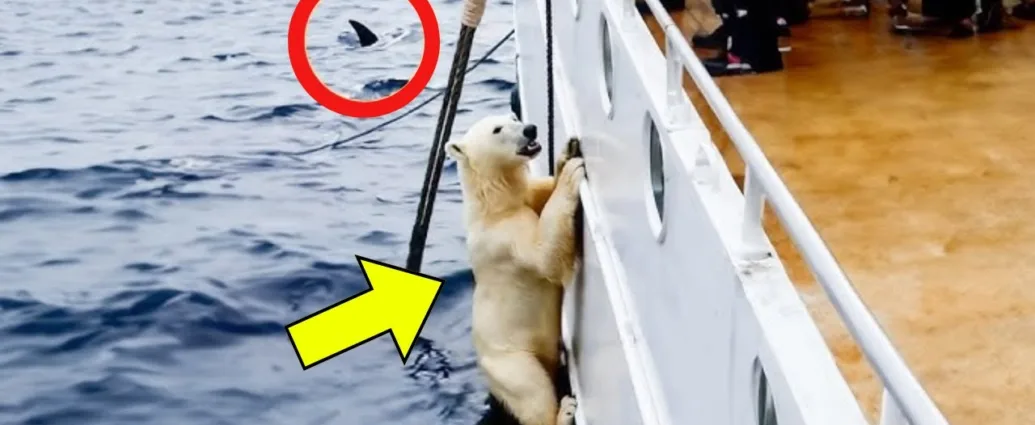
George had been on the water since before sunrise.
The ocean was calm that morning, a rare gift after weeks of unpredictable weather. His small fishing vessel moved steadily across the surface, the engine humming quietly as seabirds circled overhead. For George, this was routine. He had spent decades fishing these waters, documenting marine life, and working closely with environmental authorities to protect endangered species. The sea was not just his livelihood—it was his responsibility.
That was why, when he noticed something unusual in the distance, his first reaction was concern rather than fear.
At first, it was just a dark shape cutting through the water. Large. Too large to be debris. George slowed the boat and raised his binoculars. What he saw made his breath catch.
A bear.
Not on land. Not near shore.
Swimming.
Bears were strong swimmers, but they rarely ventured far from land unless something was seriously wrong. George had seen many animals in distress over the years, and every instinct he had told him this was not normal behavior.
As the boat drifted closer, the bear changed direction.
It was heading straight toward him.
An Unusual Encounter
George felt a surge of adrenaline. A bear approaching a boat in open water was dangerous—unpredictable. He motioned for his crew to stay back while he cut the engine to idle speed.
The bear reached the boat and circled it slowly.
It didn’t roar.
It didn’t lunge.
It didn’t show aggression.
Instead, it lifted its head slightly, eyes fixed on George, and let out a low sound—not a growl, but something closer to a strained breath.
Then it swam away.
After a few meters, it stopped and turned back, looking directly at the boat.
George felt a chill run down his spine.
It was waiting.
“I think it wants us to follow,” he said quietly.
The crew stared at him in disbelief.
“George, that’s a bear.”
“I know,” he replied. “But something’s wrong.”
Against every rule of self-preservation, George restarted the engine and followed the animal at a safe distance. The bear swam steadily, conserving energy, as if it knew exactly where it was going.
After nearly forty minutes, land appeared on the horizon.
An island.
The Island That Wasn’t on the Map
The island was uninhabited and rarely visited. Dense forest covered most of it, with jagged rock formations along the shoreline. As they approached, George noticed how quiet it was—no birds, no movement.
The bear climbed onto the rocky shore and waited.
George anchored the boat and instructed his crew to remain alert. He carried only basic safety equipment—nothing that would protect him if the bear decided to attack.
But it didn’t.
The bear walked slowly toward the forest, stopping occasionally to look back, ensuring George was still following.
Every step raised George’s unease. Bears were territorial animals. Leading a human into the forest went against everything he knew.
And yet, the animal’s behavior was deliberate. Controlled.
As they moved deeper into the trees, the air grew heavy. Then George smelled it—a sharp, organic scent that made his stomach tighten.
He saw her.
The Second Bear
Lying on the forest floor was a second bear.
A female.
Pregnant.
She was massive, but frighteningly still. Her breathing was shallow, labored. Her sides rose and fell unevenly, and her eyes barely reacted to movement around her.
The male bear let out a low sound and stood beside her.
George understood immediately.
This wasn’t coincidence.
This was intention.
The male bear had sought help.
A Race Against Time
George backed away slowly and contacted the nearest wildlife veterinarian using his satellite phone. The moment he described the situation, the tone on the other end changed.
“This is extremely dangerous,” the vet said. “I’ve never heard of anything like this.”
She requested immediate assistance from wildlife rangers and coastal police. The bear’s condition sounded critical, and surgery might be the only option.
While waiting, George’s crew contacted other fishermen nearby. Backup arrived quickly, forming a perimeter around the clearing to prevent the bears from wandering deeper into the forest.
The female bear’s condition worsened.
She tried to stand once and collapsed.
By the time authorities arrived, sedation was the only safe option.
Suspicion and Silence
As the veterinarian prepared to assess the bear, police officers approached George.
“Sir, we need to ask you a few questions.”
George complied without hesitation. He explained his role as an environmental contractor, his long-standing cooperation with authorities, and his recent reports of suspicious activity in the area.
Illegal fishing.
Poachers.
Unregistered vessels.
The officers listened carefully.
Then the veterinarian called out.
“I need police assistance immediately.”
The Hidden Threat
An ultrasound revealed a large, solid mass near the entrance to the bear’s stomach. It wasn’t a natural growth. It wasn’t a pregnancy complication.
It was foreign.
The vet palpated the area carefully and confirmed it.
“The bear swallowed something it can’t digest,” she said. “And it’s blocking her system.”
There was no time to transport her. Surgery would have to happen there—in the forest.
The risk was enormous.
But letting her go meant certain death.
A Dangerous Operation
As preparations were made, the sedation began to wear off. The bear stirred, growling weakly. Without additional tranquilizers, she could wake fully at any moment.
Fishermen and rangers worked together, blocking pathways with logs and debris to prevent her from escaping—or attacking.
Tension filled the clearing.
When the veterinarian finally arrived with additional sedatives, the situation was near collapse. The bear lunged once, narrowly missing a ranger.
The vet moved fast.
She approached when the bear turned its head, injected the tranquilizer, and retreated. Within minutes, the massive animal slowed, then collapsed into unconsciousness.
Everyone exhaled.
The Surgery
The veterinarian worked with precision, her hands steady despite the circumstances. She made a careful incision along the swollen area.
Layer by layer, she exposed the obstruction.
What emerged stunned everyone.
A fish.
Undigested.
Inside it—something metallic.
Glowing faintly.
A microchip.
Silence fell over the clearing.
A Dark Explanation
George’s mind raced.
Weeks earlier, he had intercepted poachers using advanced tracking equipment—technology far beyond what illegal fishermen typically possessed. He had confiscated a device and turned it over to authorities.
He ran to his truck and retrieved it.
The police examined the device and confirmed it.
“This is a tracking system,” an officer said. “Military-grade.”
The fish had been implanted with a microchip and deliberately fed to the bear. The material prevented digestion, ensuring it would lodge in the stomach and remain detectable.
The poachers had been tracking her movements.
Waiting.
Recovery and Justice
The chip was removed, and the veterinarian completed the surgery. Aside from dehydration and exhaustion, the bear was healthy.
When she awoke, she stood unsteadily, then walked—stronger with each step—back into the forest.
The male bear followed.
Authorities used the recovered technology to dismantle the entire poaching operation. Multiple arrests were made. The network was larger than anyone expected.
Before leaving, the veterinarian turned to George.
“That bear didn’t wander into the ocean by accident,” she said. “She sent him.”
George nodded.
He would continue monitoring the area.
Not as a fisherman.
But as a guardian.
Beneath the Surface
Long after the forest grew quiet again, George stood alone at the shoreline.
The ocean moved as it always had—indifferent, vast, and full of secrets.
He realized something then.